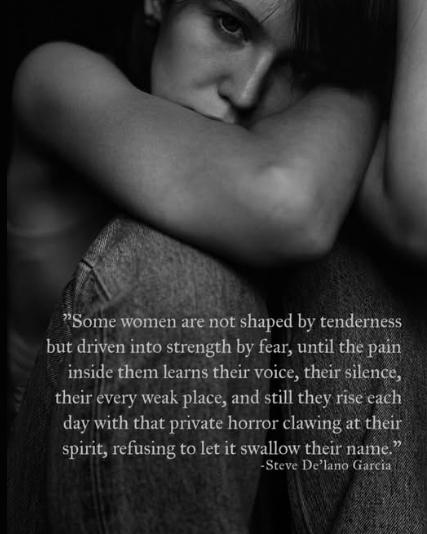
"Some women enter life already being hunted by something no one else can see. Before they have language for fear, fear has already entered them, settled into the body, and begun shaping the way they breathe, the way they listen, the way they brace for impact. They do not drift into womanhood through innocence or ease.
They are driven into it through dread, through confusion, through the early knowledge that tenderness can turn without warning and that safety can vanish while adults continue speaking as though nothing has happened. By the time they are old enough to understand what has been taken from them, the damage has already spread inward, rooting itself so deeply that even silence begins to feel unsafe.
Some women are not raised so much as slowly cornered by what they are forced to endure. They learn to make themselves smaller because being fully visible feels dangerous. They learn that crying may bring more harm, that telling the truth may not save them, that surviving often means swallowing what should never have been theirs to carry. A girl like this does not simply grow up; she hardens around injury while trying to keep one hidden part of herself untouched by it. She becomes divided. One self moves through the world with enough control to pass as fine, while another remains buried alive beneath fear, shame and grief, still waiting for someone to notice that she did not emerge from what happened unchanged.
For these women, memory is not a distant thing they revisit when they choose. It stalks them. It slips into the nervous system and takes hold of ordinary moments, poisoning what should be harmless. A voice, a shadow, a silence held a second too long can pull the ground from under them. Peace becomes difficult to trust because peace has so often been followed by harm. Rest becomes difficult to enter because the body has been trained to expect invasion. Even love can feel dangerous when your earliest lessons taught you that closeness may be where the injury begins. She may be standing in a safe place now, but the body does not always believe what the mind tries to tell it. It still prepares for the worst as if the worst is only moments away.
The most vicious part of this kind of suffering is that it does not end when the event ends. It continues its work from the inside. It alters the meaning of things. It teaches a woman to suspect kindness, to doubt her own instincts, to question whether she has the right to take up space at all. It can make her feel contaminated by what was done to her, as though the cruelty entered her and left some permanent mark no one else can see but she can feel constantly. She may wash, work, speak, smile, comfort others and appear intact, all while carrying the private horror of feeling as though something inside her has been left bleeding for years with no witness and no closure.
People praise women like this for being strong because strength is easier to admire than suffering is to face. They call her resilient because it spares them from asking what she had to become to survive. But there is nothing clean about this strength. It is forged in panic, isolation and prolonged fear. It is the strength of continuing after tenderness has been punished out of you, the strength of staying alive while part of you no longer feels entirely human, the strength of holding a composed face over a life within that can still descend into chaos without warning. This kind of endurance is not inspiring in the sentimental sense. It is grim, punishing and often terribly lonely.
What grows inside such a woman is not simple sadness but something far more relentless. It is a colony of old terrors, fed by memory and sharpened by time, whispering that she is never truly safe, never fully clean, never beyond reach of the past. These inner creatures do not always roar. Sometimes they speak softly in their own voice. They tell her to mistrust joy, to prepare for betrayal, to hold herself apart because closeness has a price. They can take something gentle and turn it into a threat, take something hopeful and stain it with dread before it has even had the chance to live. Fighting this day after day can leave a woman looking calm on the outside while inwardly she feels as though she is chained to a private underworld.
There is also the cruelty of how invisible this battle can be. A woman can be functioning, working, replying, caring for others, meeting expectations, and still be one breath away from collapse in a place no one sees. She can be praised for coping while every task is costing her more than anyone knows. She can be called distant when she is frightened, called difficult when she is protecting what remains of herself, called cold when warmth has too often invited harm. The world is quick to judge the shape a wounded woman takes, but far less willing to understand how she was forced into that shape in the first place.
And yet the most unsparing truth may be this: many of these women are carrying grief not only for what was done to them, but for the selves they never got to be. They mourn the girl who might have trusted easily, laughed freely, slept deeply and loved without fear. They mourn the softness that was interrupted, the innocence that was cornered, the version of womanhood that might have unfolded if cruelty had not laid claim to so much of the beginning. There is a particular anguish in realising that survival did not only demand pain; it demanded sacrifice. It took possibilities. It took ease. It took years that can never be returned.
Still, something almost feral can remain alive in a woman who has seen this much and not yet vanished beneath it. Not purity, not gentleness untouched by harm, but a stubborn refusal to let the worst thing define the whole of her existence. Even when she is frightened, even when she is exhausted, even when she feels more ghost than person, some last living part of her continues to resist. It refuses total surrender. It keeps watch over the smallest remnants of dignity, truth and selfhood as though guarding the final fire in a frozen place. That resistance may not look noble. It may look ugly, silent, desperate and severe. But it is real.
So no, not all women are born into softness or safety or stories that reward innocence. Some are born into an internal war that begins before they can name it and follows them long after others think they should be healed. Some are made to battle the aftermath of human cruelty so intimately that it takes root in the marrow of who they are. And if they keep going, if they keep dragging themselves through the dread, if they keep refusing to let those inner horrors consume every last part of them, then their existence is not a delicate myth but hard-won defiance. It is the kind of survival that does not glow. It stares back from the edge and endures."
-Steve De'lano Garcia


Comments
No comments yet. Be the first to share your thoughts!
Leave a comment