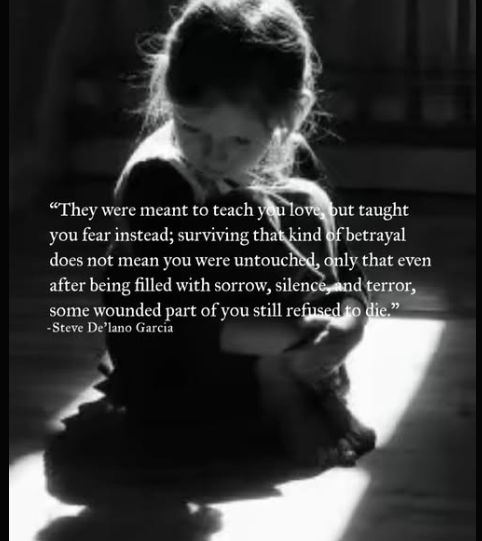
"There are betrayals so deep that they do not merely wound a life; they divide it into a before and an after, and the after is never clean again. When the people charged with your safety become the source of your fear, something foundational is torn apart, because a child is not built to defend themselves against the very hands they were meant to trust, and when that trust is violated again and again, the injury moves beyond memory and settles into the bones, into the breath, into the nervous system, until danger no longer feels like an event but like the natural climate of existence.
What is done in those years does not remain where it happened. It follows. It waits. It enters ordinary moments and poisons them from within, turning footsteps into warnings, silence into threat, kindness into suspicion, and sleep into a place where the past still knows how to find you.
Some truths are so cold that even writing them feels like touching ice with bare skin.
The most cruel part is not always the visible harm, though that alone can be enough to alter a life beyond recognition; it is the slow destruction of what a human being is supposed to learn at the beginning of life. A child should learn safety, warmth, steadiness, and care, yet many are taught vigilance, concealment, appeasement, and fear instead. They learn to read tiny shifts in tone because a single change in mood can mean disaster. They learn to make themselves smaller because being noticed can be dangerous. They learn that love can arrive wearing the face of menace, and that home can become the first place where terror is practised until it feels ordinary, expected, and impossible to explain to anyone who has never lived inside it. That is how cruelty rewrites a person: not only through pain, but through the relentless teaching of dread.
And what is taught in fear does not leave politely when the child becomes an adult.
People who have never lived through such betrayal often speak as though survival is a matter of courage alone, as though if someone is strong enough, determined enough, positive enough, they can simply rise above what happened and walk into a better life untouched. That is a comforting lie for those who do not want to look too closely. The truth is far harder and far less forgiving. Not everyone survives this kind of harm, at least not in the full sense of the word. Some are taken by it entirely. Some continue breathing while something essential has been crushed under years of terror, humiliation, and isolation. Some spend their whole lives carrying an inner devastation so severe that each day is not lived but endured. Some wounds do not close cleanly. Some injuries become part of the structure of a person’s existence. Some nights do not end when morning comes.
It is easier for the world to ask for a neat recovery than to face the scale of what was taken.
One of the first and most difficult acts of survival is understanding that it was never your fault. This can sound simple when spoken aloud, but for many it is one of the hardest truths to accept, because blame is often planted early and fed for years until it wraps itself around the mind like a chain. Children are made to feel responsible for other people’s violence. They are taught, directly or indirectly, that if they had been quieter, better, softer, more obedient, less visible, less needy, less themselves, then perhaps the cruelty would not have come. But that is a lie built to protect those who caused the harm. A child does not create their own violation. A child does not deserve terror. A child is not responsible for the failure of adults to act with care. The shame belongs entirely to those who inflicted pain and then left it inside another human being to carry.
Even after the mind understands this, the body may still resist it for years.
Because trauma does not live only in thought. It lives in reflex, in panic, in the sudden freezing of the body when a voice sharpens, in the way the chest tightens at certain sounds, in the way the skin remembers what the mind tries not to revisit. It lives in the exhaustion of always being prepared, in the instinct to apologise for existing, in the terrible habit of expecting harm even in gentle places. A survivor may know, logically, that they are no longer in immediate danger, yet the body can remain trapped in an older time, braced for impact, unable to rest, unable to trust, unable to fully believe in safety because safety was once promised and then turned into deception. This is one of the cruellest legacies of sustained harm: the danger ends, yet it keeps living inside you, speaking through pulse, breath, muscle, and fear.
To carry that invisible alarm through everyday life is a kind of exhaustion that language often fails to hold.
Then comes another battle, quieter perhaps, but just as severe: believing you are worth saving. Repeated cruelty can hollow out a person’s sense of value until they begin to think of themselves as incidental, burdensome, or undeserving of tenderness. If those who were meant to protect you treated your pain as nothing, you may grow up believing that you are nothing, or that your needs are too much, or that suffering is simply the price of being allowed to exist. This belief can become its own prison. It can keep a person in dangerous places. It can make them accept less than human dignity. It can make them mistrust kindness and shrink from love. Yet the truth remains, whether it feels believable or not: your worth was never determined by the people who harmed you. Their cruelty does not measure your value. It exposes their emptiness, their failure, their moral collapse. Your life had worth before they touched it, during every moment they tried to diminish it, and after every attempt they made to convince you otherwise.
This is not sentimental comfort. It is a necessary truth dragged into the light.
Still, there must be honesty about what survival actually looks like, because false promises can wound almost as deeply as silence. You may never get over it in the way people casually expect. You may never become untouched by the past. There may always be places in you where grief remains active, where fear still rises too quickly, where memory arrives not as a recollection but as a force. Acceptance is not peace in the simple sense, and it is not forgiveness forced into the mouth of someone who was wronged. It is the hard, unsparing recognition that this happened, that it mattered, that it changed you, and that no amount of wishing can erase its imprint. To accept is not to excuse. It is not to soften. It is not to say it made you stronger in some noble way. Often it simply means refusing to spend the rest of your life arguing with facts that have already marked your body and mind, while still insisting that what was done to you will not be the only truth of your existence.
That insistence can be quiet, and still it can be immense.
Loneliness grows thick around this kind of suffering. It settles in because cruelty is often hidden, denied, minimised, or misunderstood, and because many survivors become experts in disguising distress long before they are old enough to name it. They laugh when they are afraid. They function while barely holding themselves together. They learn to speak around the truth rather than through it. They sit in crowded spaces and feel entirely separate from the world, as though everyone else was handed a map for living that they somehow never received. There is a particular sorrow in being surrounded and still unreachable, in hearing ordinary conversation while carrying memories too heavy to place into it, in wanting to be known and fearing that if anyone truly sees what lives inside you, they will step back in horror. So the silence continues, and the silence itself becomes another injury.
Some people die in plain sight because no one recognises the depth of their inward suffering.
That is why speaking matters, even when the voice trembles, even when the words come out fragmented, even when saying the truth feels like tearing open something that never healed properly in the first place. Others are living in that same private night, believing they are alone in what was done to them, believing they are filthy with another person’s crime, believing the world has no place for someone marked in this way. They need something more than platitudes. They need honesty. They need language that does not dress up cruelty as misfortune or soften violence into something polite and manageable. They need to know that the aftermath can be vicious, that survival can be ugly and uneven, that grief can stay for years, and that none of this makes them weak, shameful, or beyond help. Sometimes the most life-preserving thing one person can offer another is not a cure, not a solution, not a promise of easy healing, but the solid and unwavering truth: I believe you, it was not your fault, and you are not the only one carrying this.
For some, those words arrive too late. For others, they arrive at the edge and make all the difference.
So if you have endured betrayal at the hands of those who should have loved you, let this be said without softness and without retreat. What happened to you was a profound violation. It was wrong in every possible sense. The fear it created was real. The sorrow it left behind is real. The loneliness, the anger, the numbness, the confusion, the shame that was forced onto you, the weariness that settles into the body after years of internal war, all of it is real. You do not need to make it smaller to make other people comfortable. You do not need to package your suffering into something elegant or instructive. And though you may never be free of it entirely, though part of you may always carry the cold imprint of those years, your existence remains more than what was done to you. If you continue, even slowly, even painfully, even with fear still following close behind, you become evidence that cruelty did not finish the story. And somewhere, in silence you may never hear, another person standing in the same shadow may see that evidence and choose, for one more night, not to disappear."
-Steve De'lano Garcia




Comments
No comments yet. Be the first to share your thoughts!
Leave a comment