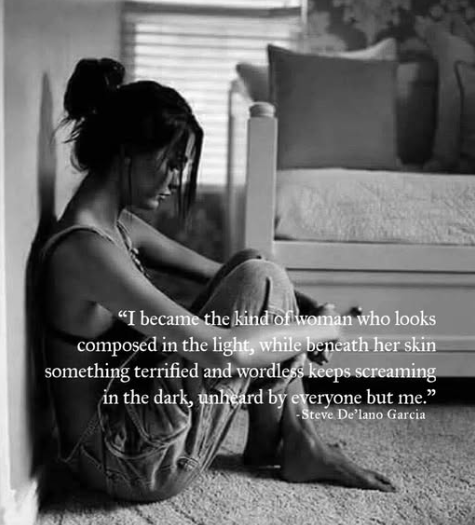
"There are mornings when I wake with my jaw already clenched, as if some buried part of me has spent the night trying to call for help through a mouth that has forgotten how to open.
The daylight does not arrive kindly. It spills across the bed like an accusation, exposing the shape of a woman who looks intact from a distance and undone up close. I lie still and listen to the machinery of myself continue without my permission: the slow drag of breath, the stubborn pulse in my throat, the faint tremor in my hands. It is a strange thing to remain alive when so much inside you has already gone quiet. People speak of silence as if it is gentle, but there is nothing gentle about this kind. It presses against me with the weight of wet soil. It fills my chest. It sits on my tongue. It follows me from one hour to the next like a witness waiting for me to confess.
I have become skilled at appearing ordinary in the presence of others. I can stand in a kitchen and ask if anyone wants tea. I can nod at the right time. I can answer questions with a voice so calm it almost passes for peace. Yet beneath that surface, there is a constant violence in the effort of containing myself. Every simple exchange feels like holding shut a door while something on the other side throws itself against the frame. My face has learned obedience. My body has learned stillness. But inwardly there is a woman on her knees, striking the floor with both fists, begging for one true sound to escape her before she disappears beneath her own restraint. No one sees her. No one hears the air being crushed out of her. They only see the practised expression, the acceptable posture, the careful hands folded as if prayer and surrender were the same thing.
Age has not brought wisdom so much as exposure. With each passing year, I feel less like I am growing into myself and more like I am being stripped back to some frightened earlier version I never managed to save. The body changes and calls it maturity, but fear remains primitive. It does not become refined. It crouches where it always has, small and watchful and easily startled. There are moments when I catch my reflection and feel a jolt of estrangement so sharp it is almost physical. The woman in the glass wears my face, but her eyes carry the stunned look of someone who has stood too long in a place no one should have to endure. She is older now, yes. The skin tells its own history. The shoulders slope with what they have carried. But somewhere beneath that visible life is a child still flinching at shadows, still waiting for tenderness that never learned the way to her door.
My body has become less a home than a sealed enclosure. It keeps me standing, walking, speaking, but it does not release me. There are days when my skin feels too tight for what I contain, when each breath seems to scrape against the inside of my chest as though my ribs were bars and my lungs a trapped thing pressing blindly against them. I do not mean this delicately. I mean that existing can feel coarse, physical, humiliating. It can feel like being pinned beneath your own flesh while the world congratulates you for functioning. People admire endurance because they do not have to live inside its true shape. They see survival and call it strength. They do not see the cost. They do not see the private collapse that follows every public display of composure. They do not see the exhaustion that settles in the bones like cold iron.
There is grief in being unheard, but there is another grief in realising how little the world pauses for suffering unless it arrives in a form that can be neatly displayed and quickly understood. If your pain is messy, prolonged, and difficult to name, people grow impatient. If you cannot present your despair as a lesson, a recovery, or a pleasing arc towards healing, they begin to look away. I have felt that turning. I have watched attention dim in the eyes of those who preferred a softer version of what I carried. They wanted sadness they could comfort, not the kind that stains everything it touches. They wanted honesty with boundaries, grief with manners, pain that thanked them for noticing. What they did not want was the full truth: that some suffering does not teach, does not elevate, does not cleanse. It simply remains, and remains, and remains, until a woman begins to feel like a ghost trapped inside her own life.
At times, I sense myself slipping from the edges inward. Not dying, not exactly, but thinning. Becoming less solid in myself. I can be in the middle of a conversation and suddenly feel far away, as if my body has stayed behind to perform the role while something essential in me has retreated to a place beyond reach. That is the most frightening part, perhaps—not the anguish itself, but the gradual erosion of presence. The way a person can continue moving through the expected motions while inwardly vanishing. There is no dramatic collapse in it. No grand spectacle. Only a slow unmaking so quiet that others mistake it for calm. They call you composed because they cannot imagine that numbness can look so tidy. They call you strong because they do not recognise that sometimes stillness is not resilience but surrender.
Night is often the worst of it. In daylight, there are tasks, noises, interruptions, and obligations that force a woman to remain tethered to the visible world. But after dark, when the house settles and every object becomes a shape with intent, there is nowhere left to hide from the mind. The hours lengthen. Every remembered wound grows larger in the absence of distraction. Regret takes on a body of its own. Shame sits at the foot of the bed with patient authority. Old fear returns in a fresh coat, standing just beyond sight yet close enough to change the air. I have known nights when the silence in the house felt so immense it seemed to listen back. Nights when even my own breathing sounded intrusive, as though I had no right to disturb the stillness with proof that I remained here. It is in those hours that dread becomes almost holy in its severity. Not loud, not theatrical, but absolute.
There are urges I do not romanticise. The desire to claw out of myself. To peel away every layer that has been touched, named, expected, consumed. To become unrecognisable even to my own memory. This is not drama. It is desperation in its most stripped form. When pain cannot leave through language, it seeks another exit. It moves into the muscles, the scalp, the throat, and the fists. It makes a woman want to tear at her own skin simply to prove she is not made entirely of numbness. And yet even then there is restraint. Even then there is the old discipline, the old command to stay presentable, stay quiet, stay manageable. So the violence turns inward, where no one has to acknowledge it. The body keeps the score in hidden ways: the migraines, the shaking, the exhaustion that no amount of sleep relieves, the sudden floods of tears that arrive without warning and leave almost as quickly, like a storm ashamed of being seen.
What devastates me most is not only the suffering itself but the persistence of longing within it. Even now, after all the hardening, some part of me still aches for gentleness. Still waits for a voice that does not demand, dismiss, or turn cold at the sight of need. There is something particularly cruel in the survival of tenderness inside a woman who has had to carry so much alone. It would be easier, perhaps, to become entirely unfeeling. To shut every door and let nothing living remain. But that is not what has happened. Instead, the softest parts have endured in secret, which means they can still be injured. I can still be wounded by indifference. I can still be undone by a kindness that arrives too late or leaves too soon. I can still stand at the edge of myself and wish, with a force that shames me, to be held without having to first explain the extent of my damage.
There is also anger, though women are seldom permitted to speak of it plainly unless it has been tidied into something useful. Mine is not useful. It does not inspire. It does not cleanse. It sits low and heavy, fed by every time I swallowed what should have been shouted, every time I made myself smaller so that others could remain comfortable in my presence. I am angry at the years taken by mere endurance. Angry at the hands that were absent when they should have reached. Angry at the eyes that looked and chose not to see. Angry at the expectation that suffering borne quietly is somehow more dignified than suffering named aloud. There is a cruelty in what women are taught to survive with grace. Grace is often only painful when its mouth is covered. I know this now. I know how many of us have been praised not for living fully, but for disappearing elegantly inside our own restraint.
And still, despite everything, morning comes. Not as redemption. Not as relief. Simply as a continuation. The body rises because it has not yet been granted another choice. The mirror waits. The kettle boils. Messages arrive. The world asks for the usual performance, and often enough I provide it. But beneath every ordinary gesture there remains another reality, severe and unsheltered, where a woman stands at the centre of herself and hears the full force of what she cannot say. She is not dramatic. She is not weak. She is carrying a silence so immense it has nearly become a second body. She is carrying years that never settled, fear that never loosened, grief that never found a proper witness. She is still here, and that fact is less comforting than people imagine. Sometimes remaining is not a hope. Sometimes it is simply what happens when the body refuses to follow the mind into its deepest pit.
So this is the truth of the unspoken: it does not sit quietly in a corner waiting to be translated. It grows. It spreads through the inner life like a stain through cloth. It alters posture, sleep, appetite, memory, and trust. It teaches the mouth to shape harmless words while the soul stands behind them, beating its fists against a wall no one else can see. It turns a woman into her own locked house, filled with echoes, with pressure, with the soundless force of all she has had to contain. And if there is anything more desolate than crying out and receiving no answer, it is reaching the point where even your own voice no longer feels like it belongs to you. Then the silence is complete. Then the fear settles into its throne. Then the world continues, polished and indifferent, while within you something vast and unsheltered keeps screaming into a void that does not answer back."
-Steve De'lano Garcia



Comments
No comments yet. Be the first to share your thoughts!
Leave a comment