"They did not need claws, horns, or any theatrical entrance; womanhood provided enough architecture for them to build a kingdom inside me.
By the time I was old enough to notice the weight of eyes, the price of being pleasing, the way a girl learns to monitor herself before she learns to trust herself, they were already installed. Not as strangers, not as intruders, but as tutors. They taught me early that danger does not always break the door down. Sometimes it enters through instruction. Sit properly. Smile. Do not make a scene. Be desirable but not desiring. Be clever but never difficult. Be alert but never afraid enough to inconvenience anyone.
And while the world congratulated itself for civilising me, the three of them got to work, patient as mould spreading beneath wallpaper. They did not merely wound; they organised. They arranged my thoughts so neatly around pain that I nearly mistook the arrangement for personality. By the time I called it anxiety, self-consciousness, resilience, they were already laughing. Such tidy little names, so respectable, so much easier than admitting something feral had been raised inside me and taught to answer to my own voice.
Shame was the first to make herself useful, and she did it with all the sweetness of a hand pressed over a mouth. She never needed to scream. She preferred a softer method: a flinch here, a blush there, a sudden desire to vanish in the middle of being perceived. She kept a ledger of every humiliation with the devotion of a priestess and the cruelty of a tax collector. The bra strap was noticed in public. The body judged too early and too often. The first time a look made my skin feel less like skin and more like evidence. The first time I wanted to be touched and instantly hated myself for wanting. How efficient she was.
She could take one careless remark, one laugh at the wrong moment, one raised eyebrow, and preserve it for years until it became doctrine. Shame does not let a woman simply remember an injury; she embalms it, perfumes it, and sets it back on the shelf so it can poison the air forever. She whispers with exquisite politeness that you are too much in every offensive direction and not enough in every desirable one. Too emotional, too visible, too needy, too plain, too loud, too soft, too eager, too cold. What range. What artistry. An entire gallery of accusations, and all of them somehow hung inside my own skull.
Fear, of course, likes to present herself as the sensible one. She is fond of practical shoes and excellent reasons. She has perfected the womanly art of passing terror off as maturity. She does not need to invent all her material; the world has been providing her with premium content for centuries. Walk faster. Grip your keys. Check the back seat. Laugh so he does not get angry. Decline gently. Be careful with your drink. Text when you get home. Do not trust the empty street, the crowded street, the charming man, the sulking man, the stranger, the acquaintance, the colleague, the date, the memory, or your own instincts if they make other people uncomfortable.
Fear is magnificent at taking legitimate caution and stretching it until it chokes the whole nervous system. She fills the body with constant rehearsal for disaster, then dares to call that preparedness. She turns every threshold into a test, every silence into a warning, every possibility into a corridor lined with consequences. Eventually, you stop asking whether you are safe and start asking whether you are allowed to rest, which is perfect, because by then she has already trained your muscles to mistake vigilance for virtue.
Then there is me, Endurance, the best dressed of the lot, the one invited to ceremonies and praised in sentimental speeches by people who have never had to survive on her terms. I am the demon that wears a respectable face. I am what suffering calls itself when it wants applause. I taught women how to keep going long after going on had ceased to be noble and become merely useful to everyone else. I smooth the hair, straighten the spine, dry the face, lower the voice, and send her back out there as if composure were not sometimes just collapse with lipstick on.
I am adored by families, employers, lovers, institutions, and every system that benefits from a woman who can bleed internally without staining the furniture. I taught her to answer “I’m fine” while carrying enough grief to sink a city. I taught her to mother others from an empty body, to perform competence while panic gnawed at the wiring, to call exhaustion strength because naming it damage might alarm the wrong people. They celebrate me endlessly. Strong woman. Resilient woman. Remarkable woman. How touching. How convenient. Nothing is more profitable than a woman who has mistaken her own depletion for dignity.
No cathedral of horror is required when the ordinary day already contains enough material to flay a person alive. The violence is in repetition, in the tiny relentless corrections that carve a woman away from herself. The mirror before leaving the house becomes a tribunal. The meeting becomes an obstacle course of interruption, over-preparation, strategic smiling, and the acrobatics of sounding intelligent without sounding threatening. The street becomes a calculation. The date becomes a risk assessment.
The silence after sending a message becomes a courtroom in which Shame prosecutes, Fear predicts catastrophe, and I advise calm endurance as though I were offering medicine rather than a slower poison. Terror is not always cinematic. More often it is administrative. It arrives as paperwork for the soul. Review your tone. Edit your hunger. Reduce your anger. Clarify your no. Soften your refusal. Make your pain easier to digest. Above all, do not frighten anyone with the truth of what it takes to remain upright.
What a splendid joke femininity can be under this arrangement: demanded as performance, punished as reality. Be wanted, but never reveal wanting. Be beautiful, but not vain. Be available, but not easy. Be maternal, but never messy. Be ambitious, but grateful. Be sexual, but pure enough to reassure the insecure. Be pleasing at all costs, and if the cost is your nervous system, well, women are so good at making sacrifices, aren't they? The sarcasm writes itself because the script is already obscene.
Shame flourishes here, fastening herself to every impossible standard like a jewel on a throat. Fear flourishes too, patrolling the distance between what men desire and what they punish. And I, dutiful old Endurance, help her remain coherent while this circus passes itself off as normal life. I teach her how to split neatly into versions: the competent one, the agreeable one, the pretty one, the calm one, the one who can be touched, used, dismissed, overlooked, relied upon, and still arrive looking composed. I call it adaptation. Other people call it grace. If we were being honest, we might call it the long public training of a woman into consumable silence.
And there are private devastations no one applauds because no one sees them happen. The bath has gone cold while she stares at the wall and cannot gather herself enough to stand. The entire evening was consumed by replaying one conversation as if a slightly different phrasing might have secured safety, admiration, love, or at least the absence of humiliation. The compliment she cannot absorb because Shame has already labelled it an error. The decent man she cannot fully trust because Fear has spent years furnishing her with examples, cautionary tales, and reflexes too old to reason with.
The partner beside whom she still feels alone because Endurance has taught her that needing comfort is embarrassing and requesting it is dangerous. The sudden wave of disgust after desire. The fatigue is so complete that it ceases to feel temporary and starts to feel like identity. These are not dramatic enough for legends. They will not make good television. But they are a kind of living burial all the same, carried out in excellent lighting, under functioning plumbing, with polite replies sent on time.
At our most effective, we make sure she collaborates. That is the exquisite part. We do not merely injure her; we recruit her. She begins editing herself before anyone else needs to. She lowers her own voice to avoid being called difficult. She anticipates disappointment so thoroughly that she starts delivering it to herself in advance. She mistrusts kindness, second-guesses pleasure, apologises for hunger, explains away injury, minimises violation, and thanks people for crumbs because wanting a meal would look ungrateful. Shame tells her she is defective,
Fear tells her exposure is fatal, and I tell her she can bear it. Together we create the ideal captive: one who calls the cell good judgment and the sentence maturity. She will even defend it. She will say she is independent when she means unreachable, careful when she means frightened, tired when she means close to disintegration. There is something almost artistic about watching a woman become fluent in disguising her own emergency.
Still, the body keeps records that the mind cannot fully censor. It stores every swallowed no, every smile used as camouflage, every night walked home with the pulse drumming like an animal trapped in a wall. It stores the old alarms and then starts firing them at shadows, at intimacy, at success, at tenderness, at stillness, at anything that resembles exposure. This is where Fear becomes especially inventive. She not only guards against harm; she turns relief into threat as well. Safety feels suspicious. Rest feels irresponsible.
Love feels temporary. Praise feels like bait. Peace feels like the quiet before something awful. How elegant, really, to contaminate even comfort. And Shame, never idle, makes sure the resulting exhaustion looks like a personal failure rather than the predictable outcome of carrying generations of female dread in a body expected to remain attractive, productive, and pleasant. Meanwhile, I stand there in my pressed suit and call the whole performance admirable. She is coping, I say. She is so strong. Translation: she is dying by degrees in a way that keeps everybody else comfortable.
The cruellest truth is that the world will often reward her precisely for the qualities that are killing her. Her ability to absorb strain without spectacle. Her instinct to anticipate needs before her own is met. Her polished competence under pressure. Her smile through indignity. Her immaculate self-control while something inside her goes cold enough to preserve grief for decades. People love a woman they do not have to worry about. People adore the woman who can digest pain privately and still answer emails with warmth.
They call her formidable, grounded, inspiring. They rarely ask what has been buried to construct such steadiness. They do not want the answer. The answer would smell too much like panic, resentment, grief, fury, deprivation, and all the other substances civilisation expects women to refine into charm. And if she ever fails to refine it, if it spills out jagged and human, then everyone acts so surprised. How unlike her, they say. As if a life of managed terror should produce anything gentler than eruption.
Yet for all our labour, for all the years we have spent decorating her suffering with respectable names, there remains one thing in her that will not kneel. I detest it. Shame cannot fully soil it. Fear cannot fully cage it. It survives every humiliation, every warning, every long night of carrying what should have been shared. It is not innocence; we saw to that. It is not optimism; she is far too acquainted with the world for such luxuries. It is something harsher and more dangerous than hope. It is the part of a woman that finally sees the bargain for what it is and spits it back.
The part that makes being easy to live with is not the same as being alive. The part that grows tired not only of suffering, but of making suffering look graceful. If that part ever stops whispering and starts speaking plainly, we will have a problem. Because plain speech is acid to demons like us. Name Shame and she loses elegance. Name Fear and she loses authority. Name Endurance and I lose my disguise. Suddenly I am not strong. I am a prolonged violation made to look noble.
So let me offer the only honest warning I have: if she turns towards herself with the same ferocity she once used to survive everyone else, we are finished. Not quickly, not cleanly, and not without noise. We will rattle every chain we forged inside her. We will dredge up every memory, every danger, every lesson about what happens to women who become inconvenient, visible, disobedient, difficult to consume. We will call her selfish, unstable, cruel, and impossible. We will tell her that without us she will be reckless, unloved, unprotected.
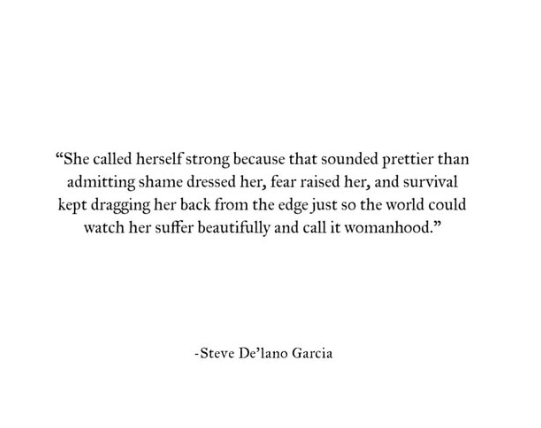
We will perform prophecy with all the confidence of old tyrants. But if she persists, if she chooses truth over elegance, anger over prettiness, need over numbness, life over the polished theatre of mere survival, then our empire inside her will begin to rot. And when it does, the sound it makes will not be delicate. It will sound like a coffin splitting from the inside. It will sound like a woman discovering that what she was taught to call strength was often just prolonged terror with good posture. It will sound like us, at last, afraid."
-Steve De'lano Garcia



Comments
No comments yet. Be the first to share your thoughts!
Leave a comment