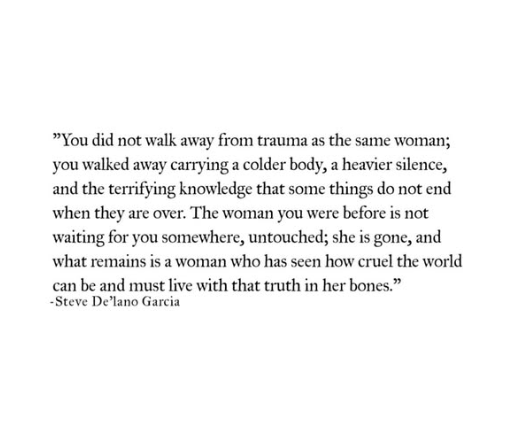
"Trauma does not merely visit a woman’s life; it seizes it, enters it with force, and leaves behind a version of existence that can resemble the old one from a distance while being, in truth, utterly and irreversibly altered at its core. She may still wear the same clothes, answer to the same name, walk the same streets, and sit at the same table, yet none of these familiar things means she has remained intact, because trauma does not need to destroy the visible structure of a life to devastate the person living inside it. It changes the atmosphere of being alive.
It changes the meaning of silence, the weight of footsteps, the significance of a glance, the danger hidden in a shift of tone, the fear contained in an ordinary evening. After certain experiences, the body no longer behaves like a neutral home. It becomes a site of memory, a place where alarm can rise before reason, where dread can flood the bloodstream faster than thought, where the past can return not as remembrance but as immediate physical fact. This is one of the hardest truths to state plainly: trauma does not simply injure a woman’s history; it colonises her present.
It is a terrible thing to discover that your own body can become the place where what happened to you continues to happen, over and over, long after everyone else has decided it is over.
There is no honest language for healing that ends with a woman becoming who she was before, because who she was before belonged to a reality that no longer exists and cannot be retrieved by hope, effort, love, therapy, or time alone. The world speaks endlessly about recovery as though it were a return, as though the highest form of survival is successful resemblance to one’s former self, but this idea is often just another cruelty dressed as encouragement. It asks the harmed woman to devote herself to an impossible resurrection. It quietly implies that the acceptable ending is one in which no one has to confront the full severity of what was done to her.
Yet trauma is not a detour from which she calmly rejoins the original road. It is an event that splits the road itself. She learns things she cannot unlearn. She sees what cannot be unseen. She understands, in the deepest parts of her nervous system, that safety is conditional, that innocence is fragile, and that ordinary life can be interrupted by terror without warning and without fairness. Once this knowledge enters a woman fully, it does not politely leave when it becomes inconvenient for other people.
The brutal truth is that some women spend years being judged for not returning to a version of themselves that was destroyed by the very thing others keep insisting should have made them stronger.
Trauma changes not only what a woman remembers, but how she remembers, how she anticipates, how she interprets, and how she inhabits every hour that follows. It can make rest feel unnatural, softness feel unsafe, affection feel suspect, and joy feel temporary enough to be frightening. The world may see her hesitation and call it guardedness. It may see her vigilance and call it overreacting. It may see her exhaustion and call it negativity. But what people often name so casually are, in fact, adaptations born from exposure to something that overwhelmed her capacity to feel safe in her own life.
She is not imagining a threat because she is weak. She is detecting a possibility because experience taught her that a catastrophe does not always arrive with warning. A woman who has been deeply harmed may listen too carefully, scan too quickly, prepare too often, and trust too slowly, not because she enjoys hardness, but because the cost of innocence was once made unbearable. She is living according to the knowledge she never wanted but now cannot discard.
What many people call damage is often a woman’s nervous system doing exactly what it learned it had to do to keep her alive when life ceased to be kind.
This is why trauma can feel so isolating even in company, because the harmed woman is often standing among people who are still participating in assumptions she can no longer share. They may speak lightly about closure, about moving on, about choosing peace, about not dwelling on the past, as though trauma were chiefly a matter of attitude rather than an experience capable of altering the body’s chemistry, the mind’s habits, and the soul’s relationship to the world. She may sit there nodding, saying very little, because to explain the full truth would require language most people do not really want to hear.
It would require saying that there are mornings when dread arrives before consciousness fully forms, that there are nights when sleep feels like surrender, that there are harmless sounds that can drag a woman back into panic with humiliating speed, that there are forms of touch that make the skin feel occupied rather than comforted, that there are days when existing in a body feels less like living and more like enduring a site of evidence. This is the loneliness of trauma: not only carrying what happened, but carrying how impossible it is to make others grasp its continued existence.
One of the cruellest consequences of suffering is that the people who ask for honesty are often the first to recoil when a woman finally tells the truth without making it gentle.
There is also grief, and it is often far more complex than grief for the event itself. A woman may grieve who she was before fear became fluent in her. She may grieve the version of herself who could walk into a day without first calculating risk, who could welcome affection without searching it for danger, who could rest without bracing, who could laugh without some quiet part of her monitoring the environment, who could inhabit her own body without feeling watched by memory.
She may grieve years given over to mere survival, energy drained into coping, relationships strained by consequences she never chose, and possibilities diminished by a nervous system that no longer distinguishes cleanly between now and then. This grief is especially painful because it is often invisible. Others see only continuity: the same woman, the same face, the same life continuing. But she knows there has been a death of sorts, not necessarily of identity in full, but of ease, trust, naivety, and the unguarded self she once inhabited without even understanding it was precious.
Some women look entirely composed in public while privately mourning the disappearance of the person they were before terror taught them to monitor every breath, every silence, every pause, every human intention.
And still, to say all this is not to declare that life ends at the site of harm. It is to reject lies about what survival actually looks like. Survival is not clean. It is not beautiful in the way people prefer beauty. It is often repetitive, inelegant, and unseen. It may look like a woman getting through a conversation while her chest tightens. It may look like forcing herself to eat while nausea rises from nowhere. It may look like declining invitations because unpredictability feels dangerous, or accepting them and paying for the effort afterwards in private collapse.
It may look like speaking calmly because she learned long ago that visible distress often invites discomfort rather than care. Many women become highly skilled at performing functionality while internally enduring a level of strain that would horrify those around them if it were made visible. The world praises this as resilience because the world is more comfortable with well-managed suffering than with suffering that refuses to be hidden.
A woman is often called strong when what is really meant is that she has learned how to bleed inward without disturbing anyone.
This is why the language of triumph can feel so false. Not every survivor wants to call herself empowered. Not every woman wants to describe what happened as a lesson, a gift, a source of growth, or the making of her. Some experiences are not meaningful in any noble sense. Some experiences are simply violent in their consequences. Some truths remain ugly no matter how eloquently they are framed. There is dignity in refusing to decorate devastation. There is sanity in rejecting the pressure to transform deep injury into a socially pleasing narrative.
A woman may indeed become wiser, clearer, more discerning, and more resistant to illusion after trauma, but these gains do not cancel the cost. If she becomes harder, it is because softness was punished. If she becomes suspicious, it is because trust was violated. If she becomes difficult to reach, it is because access once came with danger. These are not inspiring side effects. They are evidence. They testify to the severity of what happened far more honestly than any polished statement about personal growth.
Sometimes the most truthful thing a woman can say is not that suffering made her better, but that it made her someone who now has to work every day to keep pain from swallowing what is left of her life.
Yet there is a form of healing still possible, though it is sterner and less comforting than most people wish to admit. It is not healing as erasure, and it is not healing as return. It is healing as recognition, as adaptation, as the disciplined refusal to deny reality. It is a woman deciding that she will no longer measure her worth by how convincingly she can impersonate her untouched self. It is the gradual building of a life that accommodates the truth instead of punishing her for it.
It is learning what calms the body without expecting the body to forget. It is establishing boundaries not because she is bitter, but because she now understands what access can cost. It is allowing herself to be altered without concluding that the alteration has made her lesser. It is speaking in plain terms about the permanence of certain effects. It insists that the presence of continuing pain does not mean she has failed. This kind of healing is not warm or sentimental. It is grave, deliberate, and profoundly honest.
Real healing is sometimes nothing more glamorous than a woman finally stopping the humiliating labour of pretending that what devastated her should have left no permanent mark.
There is strength in such honesty, though not the kind most people celebrate. It is not the strength of dazzling recovery stories or effortless grace under pressure. It is the strength of remaining present inside a life that has been made heavier by what it contains. It is the strength of acknowledging fear without surrendering every decision to it. It is the strength of telling the truth even when that truth is awkward, severe, and inconvenient for those who prefer narratives with clean endings.
It is the strength of understanding that one can be deeply altered and still deserving of tenderness, respect, and rest. A traumatised woman does not need to be purified by suffering to earn compassion. She does not need to display optimism on demand. She does not need to prove her worth by becoming easy to love after enduring what was hard to survive. Her existence is not more valuable if she can package her damage attractively.
Too many women are expected to turn their worst pain into something digestible, graceful, and uplifting, as though suffering only becomes respectable once it stops frightening everyone else.
So no, trauma is not something a woman simply gets over, because what happened to her does not remain politely confined to a chapter that has ended; it reaches into the architecture of daily life and alters what safety, intimacy, rest, memory, and even personhood itself can feel like from then on. It may become more manageable. It may become less consuming. It may loosen its grip in certain areas while retaining it in others. But the deepest truth is that trauma leaves a new reality in its wake, and healing begins only when this is faced without illusion.
The goal is not to go back. The goal is not to become evidence that suffering can be neatly resolved. The goal is to live truthfully inside the altered life that remains. To say: this happened, it changed me, some of what it changed will stay changed, and I will not betray myself by pretending otherwise. If there is dignity after trauma, it is found there, in the unsentimental courage of a woman who no longer chases restoration, but instead claims the harder right to exist fully as someone marked by what she endured.
She does not carry a memory alone; she carries a changed way of being alive, and that is a burden far heavier than most people will ever have the courage to understand."
-Steve De'lano Garcia




Comments
No comments yet. Be the first to share your thoughts!
Leave a comment