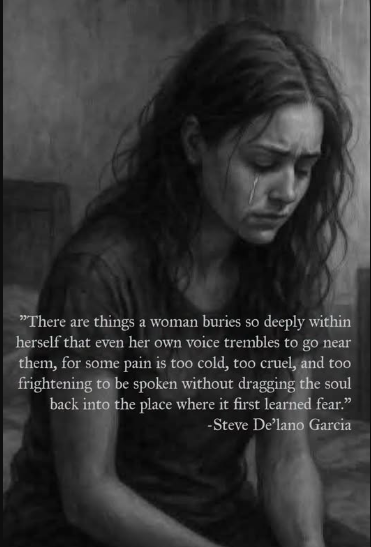
"There are truths a woman does not keep silent because she wishes to be mysterious, private, or difficult to reach, but because what happened to her entered so deeply into the centre of her being that ordinary language became useless long before it ever came close to touching the full shape of it, and what remains inside her is not a simple memory that can be lifted out and examined in the light, but something far heavier, far colder, and far more consuming,
something that settled into her bones when she was frightened, defenceless, and far too alone, and which has stayed there ever since like a permanent winter no one else can see, making a home inside her where comfort should have lived.
And perhaps that is the first sorrow of it, the quiet and unspeakable sorrow that sits beneath all the others: that some pain is not merely remembered, but inhabited, endured over and over again in silence, until the woman carrying it no longer knows where the suffering ends and where she begins, no longer knows whether she is holding the secret or whether the secret is now the thing holding her together and pulling her apart in the same breath.
Some experiences do not leave behind a story that can be told from beginning to end; they leave behind fragments, sensations, dread, the sound of one’s own breathing turning shallow in the dark, the dreadful feeling of being unsafe even in stillness, and the unbearable knowledge that something precious was taken from you before you had the strength, the language, or the protection to defend it. A woman may try, in some private corner of herself, to give those moments a name, to set them down in a way that appears manageable, but the truth refuses to become neat. It refuses to soften. It refuses to stand still long enough to be described without bringing all its terror back with it. So she says nothing, or almost nothing, and the world, which is often kinder to clear explanations than to wordless suffering, mistakes her silence for distance rather than injury.
And what a lonely cruelty that is, to be judged by the very quietness that was forced into you by fear, by grief, by shame, by the repeated lesson that speaking could cost you what little safety you had left, until silence stopped feeling like a decision and began to feel like the only place where you might survive another day without shattering completely in front of those who would never understand the price you have already paid.
Some injuries do not show themselves where others expect to find them. They do not always appear as visible collapse or dramatic confession. Often they live in smaller, more tragic places: in the way she apologises before she has done anything wrong, in the way her shoulders tighten when footsteps draw near, in the way kindness can make her want to cry because she has gone so long without feeling safe inside it. They live in her tiredness, in her watchfulness, in the carefulness with which she moves through the world as if danger might rise from any ordinary moment and take hold of her again. People may see only a quiet woman, a reserved woman, a woman who seems older in the eyes than she should be, but they do not see the private labour of carrying what never truly left her.
And the tragedy deepens there, in all that goes unseen, because what is hidden is not hidden for lack of importance, but because it was important enough to alter the entire structure of a life, to change the meaning of touch, trust, tenderness, sleep, memory, and love, until even the gentlest parts of existence begin to feel uncertain, and even peace, when it briefly appears, feels fragile enough to vanish the moment she lets herself believe in it.
Some truths remain untold because telling them would require a woman to return to the exact place within herself where she first learned fear so complete that it divided her from her own voice. To speak fully of such things is not merely to remember them. It is to feel them stir again with all their original force, to sense the same helplessness rise in the body, the same cold panic spread through the chest, the same awful certainty that no one is coming quickly enough to make it stop. That is why silence can persist for years. Not because the pain faded, and not because it mattered less with time, but because it never became small enough to carry in words. It remained vast, severe, and alive in all the ways she wished it were not.
And there is a particular sadness in knowing that many will never understand this, that they will ask why she did not speak sooner, why she did not ask for help, why she did not tell the truth plainly and at once, as though pain obeys logic, as though fear behaves honourably, as though a wounded soul can simply open itself on command and offer its deepest injuries to a world that has not always proved gentle with trembling things.
A woman who carries such silence often learns how to continue in ways that look almost ordinary from the outside. She learns how to answer questions without answering them. She learns how to smile at the correct moments, how to move through conversations without revealing the grief pressing against the back of her teeth, how to sit in bright places while feeling as though something inside her remains permanently dimmed. She may work, care for others, speak softly, and appear composed, all while carrying an inner sorrow so profound that even her happiest moments are shadowed by the knowledge of what she has had to survive alone. To continue like that is not simple resilience. It is endurance at its most tender and devastating form.
And in that endurance there is something almost unbearable to witness once one truly sees it: not grandeur, not triumph, but the exhausted courage of someone who has had to build a life around a pain that never asked permission to stay, someone who has had to become her own shelter whilst still trembling from the storm, someone who has had to keep going even though the world continued as if nothing had happened, whilst within her the echo of it never fully ceased.
What remains unspoken does not disappear. It settles deeper into the body. It teaches the muscles to stay braced, the sleep to stay light, the mind to measure every silence for danger. It can turn affection into confusion, safety into suspicion, and tenderness into grief for all the gentleness that should have been there sooner. A woman may be loved and still feel unreachable. She may be held and still feel alone. She may long to place the full truth in another person’s hands and yet find herself unable to loosen her grip on it, because for so long the burden has been the only proof that what happened was real, and because releasing it even slightly can feel less like relief and more like stepping unguarded into open air after years of learning that openness is where harm enters.
And this is what makes certain silences so profoundly sad: they are not empty, and they are not calm; they are crowded with tears never safely shed, words never safely spoken, cries swallowed so many times they became part of the body itself, and hopes for rescue that dimmed slowly, painfully, until survival was all that remained and even survival came at a cost too intimate for language to explain without breaking apart under the strain.
So there are secrets that do not permit themselves to be told, not because they are weak, vague, or unworthy of witness, but because they were formed in fear so deep and sorrow so complete that speech still trembles before them. They remain where the most wounded parts of a woman keep watch, where trust was once asked for and betrayed, where tenderness was needed and did not arrive, where innocence was not protected, and where the self learned that silence could be the last barrier between enduring and collapsing. If she cannot tell it, that does not make it lesser. It makes it grave beyond measure. It means the truth inside her is still so heavy, so sorrowful, and so charged with pain that even now it will not come forward without taking pieces of her with it. And there is almost nothing sadder than that: to carry within you something so immense, so grievous, and so difficult to bear that even your own voice cannot cross the distance to reach it without weeping."
-Steve De'lano Garcia




Comments
No comments yet. Be the first to share your thoughts!
Leave a comment