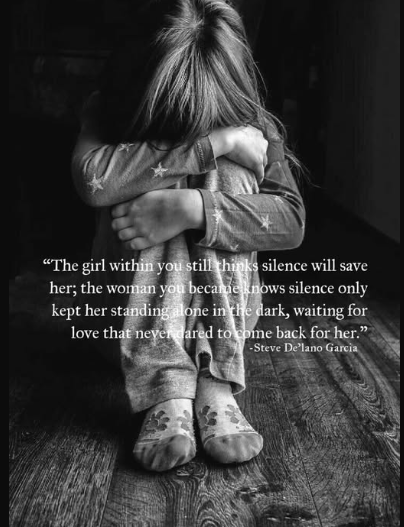
"You carry a girl inside you who never learnt how to unclench. She is still crouched somewhere deep in you, still listening, still waiting, still trying to measure danger before it has fully entered the air. She does not trust quiet because quiet was never peace. Quiet was preparation
. Quiet was the pause before something cold entered the day and made her wish she could vanish from her own skin. She learnt to become small in ways that followed her into womanhood. Not just silent, but reduced. Careful. Watchful. Eager not to take up space, as if being less visible might make her less easy to wound.
She still believes, in the oldest part of herself, that safety can be earned through obedience. That if she says the right thing, needs less, asks for nothing, causes no trouble, shows no anger, and gives no one a reason to turn hard, then perhaps this time she will be kept. Perhaps this time she will not be left standing in that familiar emptiness, staring at the place where care should have been. It is the logic of a child who had no power and had to invent some. If she could not control what was done to her, then perhaps she could control herself tightly enough to prevent it. So she made a prison out of politeness. She built it herself and called it being good.
The woman you are now knows what that little girl could not bear to know. It was never in her hands. She could have been quieter. She could have been sweeter. She could have been easier, smaller, softer, less alive. It still would not have made cruel people gentle. It still would not have made neglect turn into care. It still would not have summoned tenderness into places where tenderness had no roots. That is one of the hardest truths you have ever had to swallow: she was not failed because she lacked worth. She failed because she was placed in the path of people who could watch a child ache and remain unmoved.
There is something especially terrible about what that does to a girl. She does not simply feel pain; she begins to organise her whole self around preventing more of it. She becomes fluent in danger before she is fluent in her own wants. She learns faces, footsteps, tones, and absences. She learns when to go quiet, when to disappear, when to apologise before she even knows what for. She learns how to sense a change in the air as if her life depends on it, because in many ways it does. Other children may have learnt to play, ease, and trust. She learnt anticipation. She learnt dread. She learnt that her body was a place fear could live in for so long that it began to feel like a part of her personality.
That is why, even now, you can look composed while something ancient is shaking inside you. People may mistake your control for strength, your distance for calm, your hyperawareness for intelligence, your self-containment for maturity. They do not see the old alarm still burning under your skin. They do not see how quickly your mind can return to that earlier state, where love feels conditional, where affection feels unstable, where one wrong move might cost you everything. They do not see how exhausting it is to live as though disaster is always near, even in ordinary moments. They do not see that you were trained by fear so early and so thoroughly that your nervous system still kneels before it.
And the girl within you is still so terribly young in her grief. She still aches for impossible things. She still longs for someone to look past the surface and recognise the terror without being instructed. She still wants to be gathered up without having to make herself pitiful enough to deserve it. She still wants what was withheld to be given freely now, as though time could be made to turn back and correct itself. She wants proof that she was worth protecting before she ever learned to beg inwardly for the bare minimum. She wants to hear, from a voice she can trust, that none of it was because she was too difficult to love. And when that voice does not come from the world outside, the silence can feel like another injury.
What makes it worse is that the child inside you did not stop loving. That may be the saddest part. She did not become hard first. She became hopeful first. She kept reaching. She kept believing. She kept trying to win warmth from cold hands. She kept offering softness into places that answered with indifference or cruelty. Something is shattering in that image: a little girl, frightened nearly out of herself, still trying to be worthy in the eyes of people who should have needed no convincing. Still trying to be chosen by those who treated her as though her pain were inconvenient. Still carrying love towards the very places that taught her fear.
You know now that this is where the deepest wound lives. Not only in what was done, or not done, but in the way it taught her to turn against herself. She did what so many frightened girls do: she made herself the explanation. She decided she must have been lacking. Too needy. Too sensitive. Too much. Not enough. She took the blame onto herself because blame was easier to survive than helplessness. If it was her fault, then perhaps she could fix it. If she were the problem, then perhaps she could become different and finally be safe. Children do this because the truth is too bleak. The truth is that sometimes the people around them do not protect what is fragile simply because they do not want to, and a child should never have to understand that.
So the woman you became was built on top of that frightened bargain. You learnt to overgive. You learnt to scan. You learned to soften your needs before anyone could reject them. You learnt to endure discomfort so instinctively that you sometimes struggle to notice when you are in pain. You learnt how to be useful, pleasing, self-aware, accommodating, because somewhere inside you there is still that child who believes belonging must be paid for in self-erasure. And when people leave, withdraw, harden, or fail to choose you, it does not merely hurt in the present. It opens something old. It drags chains across the floor of your inner life. It tells the child in you that she was right all along to be afraid.
But the woman in you knows something the child never could. No one is coming to rescue her in the way she once imagined. No one is stepping backwards through time to put a stop to it. No one is arriving with perfect hands to undo what fear carved into her body. That knowledge is merciless, but it is also clean. It strips away fantasy. It ends the waiting for impossible parents, impossible love, impossible repair. And in the space where that waiting dies, another truth begins to stand up, cold and steady: if anyone is going back for that girl now, it is you. Not the frightened version of you who still begs to be chosen, but the woman who has finally learnt that choosing her is not vanity, not selfishness, not weakness. It is the bare minimum of justice.
Going back for her does not look soft. It is not sentimental. It is not a pretty act of healing wrapped in gentle language. It is fierce and unsparing. It means telling the truth without dressing it up. It means admitting that what happened marked you deeply, and that pretending otherwise has only made you lonelier. It means refusing to keep translating cruelty into excuses because honesty feels less frightening now than denial. It means standing in front of that little girl and saying what nobody said when it mattered: you did not deserve any of it. Not one second. Not one silence. Not one moment of being made to feel disposable. The wrong was never in your need. The wrong was in how your need was met.
And even then, grief does not become graceful. It comes low and heavy. It comes when you realise how early she began to disappear inside herself. It comes when you see how hard she worked for scraps of approval that should have been given freely. It comes when you understand that some part of you has been standing at an invisible threshold for years, still listening for footsteps that never belonged to salvation. It comes when you finally let yourself feel sorry for her instead of being ashamed of her. That sorrow can be almost unbearable, because she was so small, and because she should have been able to trust the world more than she did.
There is no clean ending to this. The child within you may always tremble when love feels uncertain. She may always tense when voices change. She may always wonder whether being easier would make her safer. Some injuries become part of the architecture of a life. But there is a difference now. She is no longer entirely alone in the dark of it. The woman you are can sit beside her without flinching. The woman you are can name what happened without looking away. The woman you are can stop asking her to be less to survive. And perhaps that is where something honest begins: not in forgetting, not in being untouched, but in refusing to leave her where everyone else left her.
So when you speak to her now, speak plainly. Tell her that silence did not save her. Tell her goodness did not protect her. Tell her that making herself small did not make cruel people safe to love. Tell her she was never hard to care for; she was simply surrounded by those who could witness pain and still withhold comfort. Tell her that the shame she carries was planted in her by other hands. Tell her that she does not have to spend the rest of her life kneeling before rejection as though it were truth. Tell her that the waiting is over. Tell her that nobody came then, and that fact will always ache, but tell her this as well: there is a woman here now who sees every frightened part of her, every tear she swallowed, every plea she buried alive, and she will not turn away. She will not call that child dramatic. She will not tell her to be grateful. She will not ask her to shrink. She will not leave her standing in the cold, still hoping to be claimed. She will take her by the hand at last and say, with all the steadiness the world once denied her: you were always worth saving, even when no one came."
-Steve De'lano Garcia



Comments
No comments yet. Be the first to share your thoughts!
Leave a comment